Personally Experienced · Last verified 2026-07-29
Explore Europe
Quick Take
A candid four-day Paris plan built around what is actually worth your time
- Our visits
- 2018, 2022, and 2026
- Best first-visit pace
- Four full sightseeing days
- Getting around
- Rail between cities, then the Métro
- Advance priorities
- Catacombs, Eiffel Tower, Palais Garnier, and rail
Paris is one of those cities everyone seems to say you must visit. Brian and I have now been three times—in 2018, 2022, and 2026—each time as part of a larger European trip. Apparently, we are on a four-year plan. Disneyland Paris is what first brought us there, and without it I am honestly not sure Paris would have made all three itineraries.
That does not mean Paris has nothing to offer. We have enjoyed beautiful views, excellent train journeys, memorable museums, river cruises, and a few attractions we would gladly visit again. But traffic, summer crowds, and some less-than-warm interactions have kept it from becoming one of our favorite European cities. A useful travel article should be honest about that instead of pretending every famous destination is perfect for every traveler.
This is not the exact order of any one trip. It is the four-day first-visit itinerary I would build from all three visits, including the places we repeated, the places we skipped, and one famous day trip that did not live up to our expectations.
Interactive map
Places in our Paris visits
Explore the places we visited and the additional Paris options discussed in this four-day guide. Markers are approximate where the article describes a district or cruise departure area.
Loading interactive map…
Location 1 of 18
Hôtel Palm Astotel
Our 9th-arrondissement hotel on the 2018 visit.
Map markers are approximate. Map data © OpenStreetMap contributors; tiles by OpenFreeMap.
Arrival Day: Let the Train Do the Work
We arrived in Paris by train on all three trips—twice from London and once from Germany. The stations, schedules, and onboard facilities worked well for us every time. If Paris is one stop in a larger European journey, rail can be far more pleasant than adding another flight, airport transfer, security line, and luggage wait.
The high-speed Eurostar journey from London was affordable when we booked, fun, and a major time-saver because it carried us from one city center to another through the Channel Tunnel. Our first-class tickets were worth the extra cost for reserved seating, more room, reclining seats, power, and food-and-drink service. The exact benefits and ticket names can change, so compare the current fare classes rather than relying on an old label.
European rail is not especially difficult once you have used it, but the mix of operators, station names, booking apps, ticket rules, and connection times can intimidate a first-time traveler. This is exactly the kind of trip where I can help: I can compare the complete journey, choose a sensible timetable, and make sure your train arrives at the station that best fits the rest of your plans.
A Practical Note About Luggage Storage
On one visit, we stored our luggage at the train station and found the process fairly inexpensive and easy. Storage locations and screening rules differ by station and operator, so confirm the current rules before counting on a particular facility.
Remove passports, medicine, valuables, and anything you may need during the day. We were also required to remove lithium batteries. Do not assume every locker or staffed facility accepts every suitcase, and leave extra time for security screening and retrieving your bags before the next train or airport transfer.
Where We Stayed: Hôtel Palm Astotel
In 2018, we stayed at Hôtel Palm Astotel in the 9th arrondissement. It was a short taxi ride from Gare du Nord and Gare de l’Est, with several Métro options within walking distance. The street felt pleasant, and having a good selection of nearby restaurants made the end of a sightseeing day much easier.
We would stay there again, but the room gave us a realistic introduction to Paris hotel dimensions. It was barely larger than the bed, and the bathroom was not especially conducive to two people getting ready at once. The breakfast, location, and convenience mattered more to us than floor space.
Paris has thousands of hotels, and the right choice depends on far more than the nightly rate. Neighborhood, Métro access, air conditioning, elevator access, room size, luggage, and how late you expect to return all matter. I can help narrow that enormous list to a hotel that actually fits the way you plan to use the city.
Use the Métro—and Expect Stairs
The Métro is usually a better way to cross Paris than sitting in street traffic. Stations are frequent, and many major sights are easy to connect when you group the day by neighborhood. Keep your ticket or validated fare media until you have completely exited, watch your belongings in crowded stations, and check the final train time if you will be out late.
Do not assume every station is step-free. Travelers with large luggage, strollers, or mobility needs should check the specific route in advance. A taxi can still be the better tool for a hotel transfer or the end of a long day; it simply would not be my default for every trip across the city.
Day 1: Trocadéro, the Eiffel Tower, and the Seine
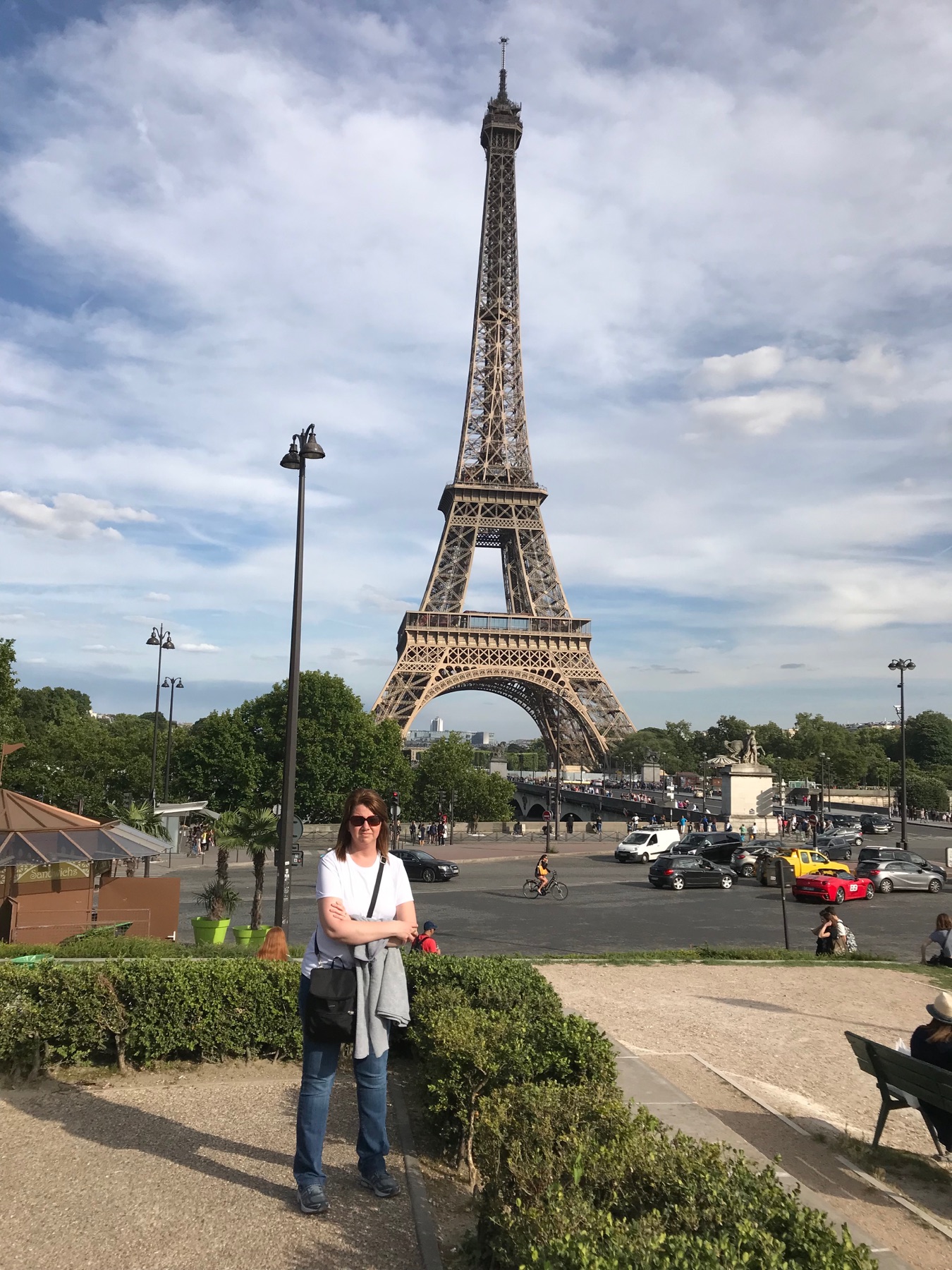
Start around the Trocadéro for a classic view across the Seine toward the Eiffel Tower, then walk through the gardens and across the river. This is one of the prettiest approaches to the landmark, and it gives you changing angles without requiring an elaborate photo shoot.
It is also extremely popular. Unless you are an Instagram model—or traveling with one—you can probably find a reasonable spot, take a few selfies, enjoy the view, and keep moving. The tower is impressive, but fighting for a people-free photograph can consume time you could spend actually experiencing Paris.
The Eiffel Tower was built for the 1889 Exposition Universelle and was not intended to become a permanent symbol of the city. If going up matters to you, reserve the appropriate level in advance and understand whether your ticket uses lifts, stairs, or a combination. We were satisfied with the changing views from the ground and the river.
Day 1 Afternoon: Take a Seine Sightseeing Cruise
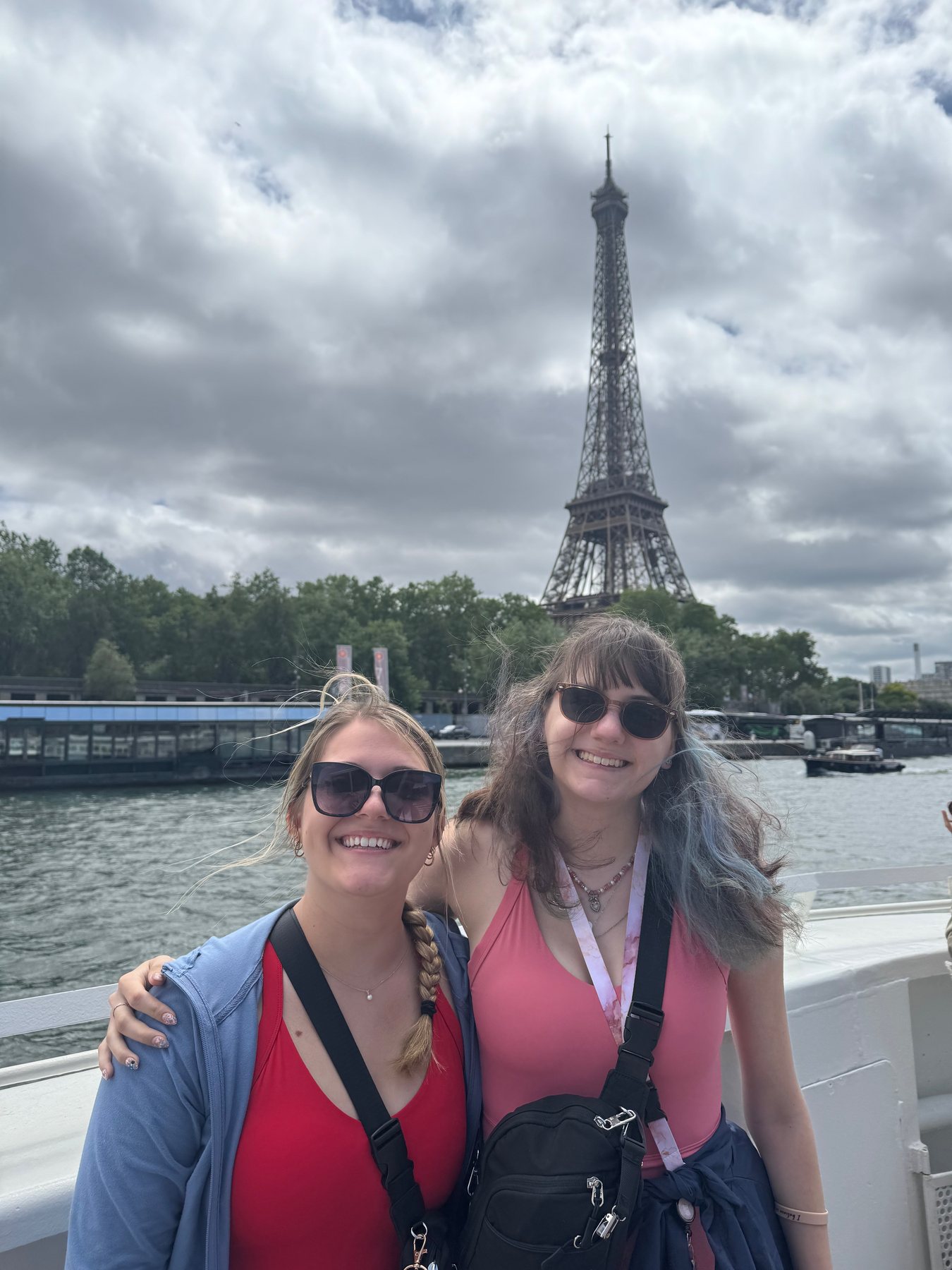
We took a Seine cruise on each of our three visits. It is an easy way to see how the city’s landmarks relate to the river, rest your feet, and get a different view of bridges, monuments, and neighborhoods you may explore later.
We bought advance tickets to speed up check-in, but still had to wait for the next departure. For an ordinary daytime sightseeing cruise, walk-up tickets may work just as well unless you are visiting at a very busy time or need a specific sailing. Several operators offer different boats, routes, dinner cruises, and evening experiences, so compare more than the first ticket booth you see.
All of our visits were in summer, when Paris stays light late into the evening. We considered a night cruise, but waiting until close to 10 p.m. for darkness was not worth sacrificing sleep. The illuminated city can be beautiful; it is simply not mandatory if the timing makes the next day miserable.
Day 1 Evening: Champs-Élysées and the Arc de Triomphe
Finish the first day around the Avenue des Champs-Élysées and the Arc de Triomphe. The avenue is famous and worth seeing once, although modern traffic and international storefronts may feel less romantic than the name suggests.
The Arc de Triomphe stands at the center of a famously busy traffic circle. Use the underground pedestrian passage rather than attempting to cross the lanes at street level. Travelers who want a broad city view can reserve access to the monument’s rooftop, but should be prepared for the climb and current accessibility rules.
Day 2 Morning: Go Below Paris in the Catacombs
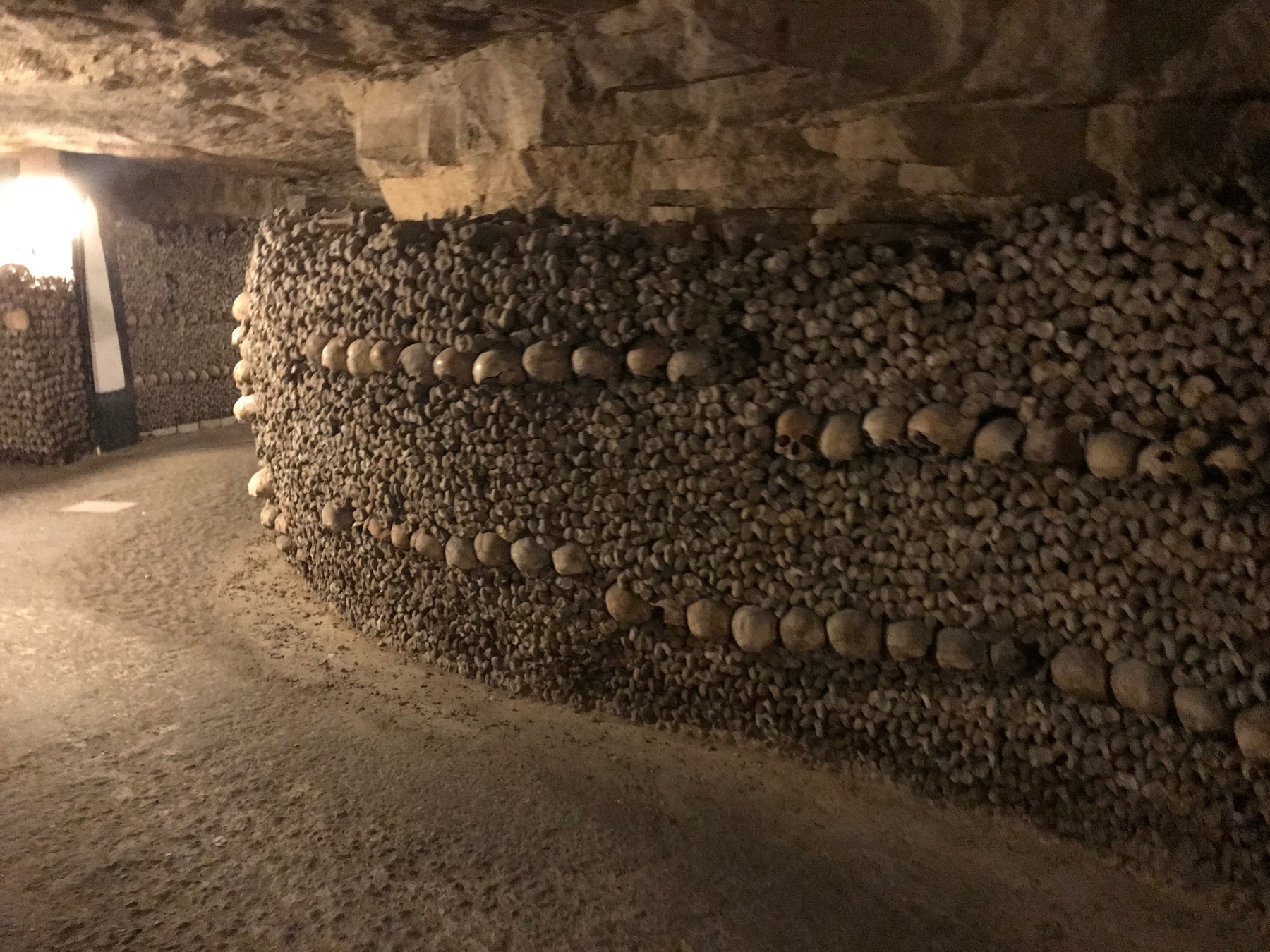
The Paris Catacombs are one of the few attractions we visited twice and would visit again. In the late 18th century, serious public-health problems in overflowing Paris cemeteries led authorities to transfer human remains into former limestone quarries. The municipal ossuary was consecrated in 1786 and opened to the public in 1809. Today, rows of skulls and long bones form the visible walls, with other remains placed behind them.
The setting is undeniably macabre, but it is more thoughtful than a haunted attraction. The route connects the geology beneath Paris, the building stone taken from the quarries, the city’s cemetery crisis, and the deliberate arrangement of an ossuary containing the remains of several million Parisians. It is strange, solemn, and genuinely interesting.
The public circuit is about 1.5 kilometers and sits roughly 20 meters underground. Expect uneven or slippery ground, narrow passages, dim lighting, 131 steps down, and 112 steps back up. The temperature stays around 14°C, or 57°F, even in summer. Large bags and suitcases are not accepted, and the site is not accessible to wheelchairs. Timed booking is strongly recommended.
Day 2 Afternoon: Tour the Palais Garnier
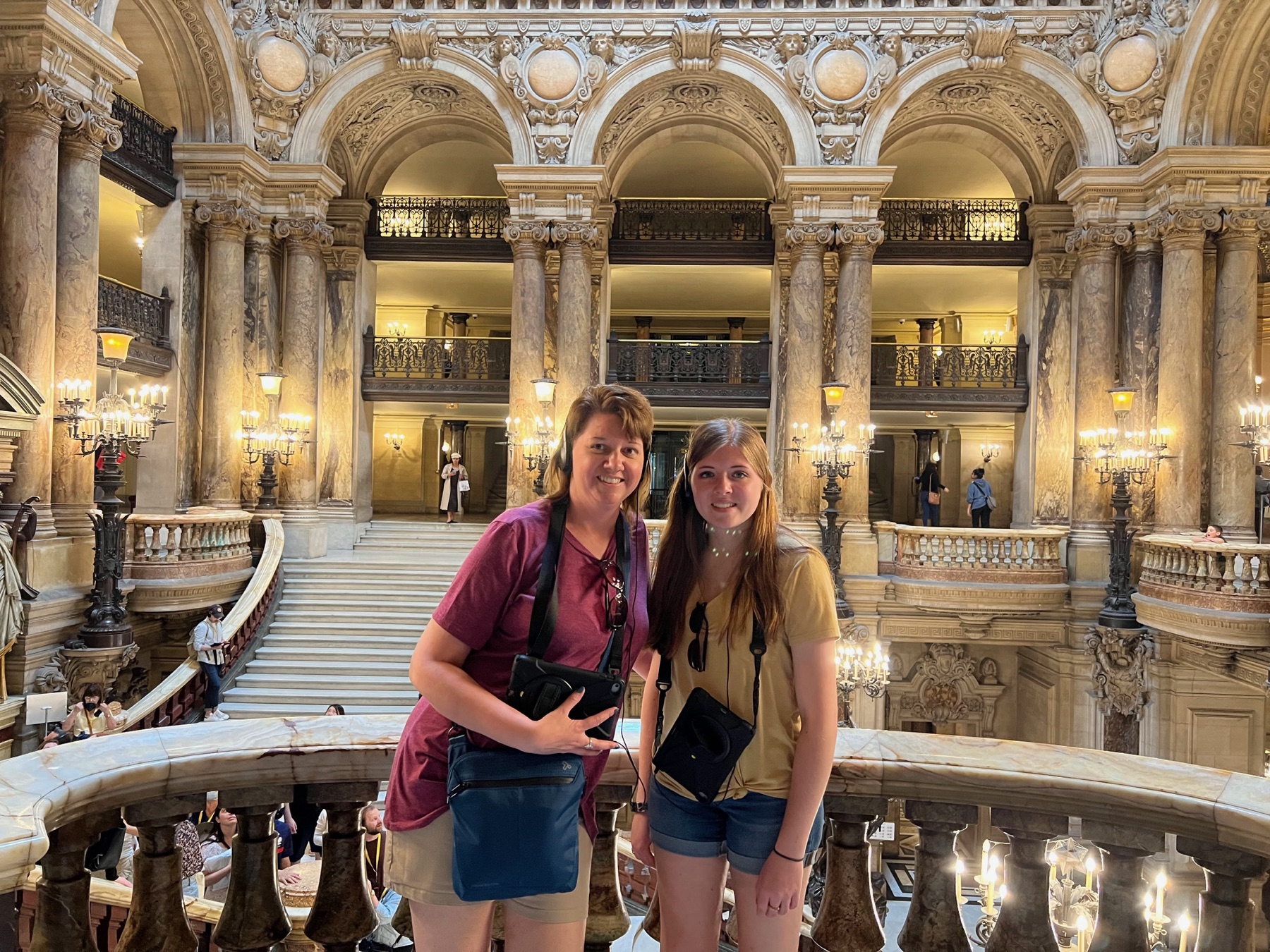
We toured the Palais Garnier twice. The building opened in 1875 and is worth visiting for its architecture even if you are not attending a performance. The Grand Staircase, painted ceilings, gilded details, balconies, salons, and Grand Foyer make the public spaces feel theatrical before you ever see the auditorium.
What we casually called the hall of mirrors is properly the Grand Foyer. Its mirrors, windows, chandeliers, paintings, and gold decoration were designed for audiences to gather and be seen. The multimedia or audio tour is worth the extra attention because otherwise it is easy to admire one elaborate room after another without understanding what you are seeing.
Fans of The Phantom of the Opera will recognize the Palais Garnier as the setting of Gaston Leroux’s novel. Box 5 is associated with the Phantom legend, although visitor access and auditorium sight lines can vary. Rehearsals and theatre operations can close portions of the building without much warning, so no daytime ticket should be treated as a promise that every room will be open.
A Quick Moulin Rouge Photo—With a Family Heads-Up
The Moulin Rouge is easy to pair with Montmartre or a ride through the 9th and 18th arrondissements if all you want is the familiar red-windmill photograph. We made a quick stop rather than attending a show.
Families with teenagers should know that the surrounding Pigalle neighborhood has a visible adult-entertainment history. Sex shops, lingerie stores, and suggestive signs are part of the streetscape, so this may prompt a few unexpected questions. It was more amusing than alarming for us, but it is better to know before casually adding the stop to a family walk.
Day 3: Choose the Musée d’Orsay Over Museum Overload
Surprisingly, we never toured the Louvre on any of our three visits. Brian went in the 1980s and can confirm that the Mona Lisa exists, is smaller than many people expect, and already attracted a crowd. We are sure the Louvre contains more than enough to justify a full day, but on a short summer visit we did not want another famous line followed by another famous crowd.
In 2026, we chose the Musée d’Orsay instead. The building began as the Gare d’Orsay railway station, and the vast arched nave and monumental clock remain part of the experience. Its collections focus primarily on art from 1848 to 1914, including a particularly strong Impressionist and Post-Impressionist collection. More than two hours was plenty of art for us without feeling like a lesser substitute.
Delaney was able to see works by artists she loves, including Monet, and the museum gave us a more manageable experience than we expected at the Louvre. Temporary exhibitions change, so treat any special show as a bonus to verify for your own dates rather than a permanent promise.
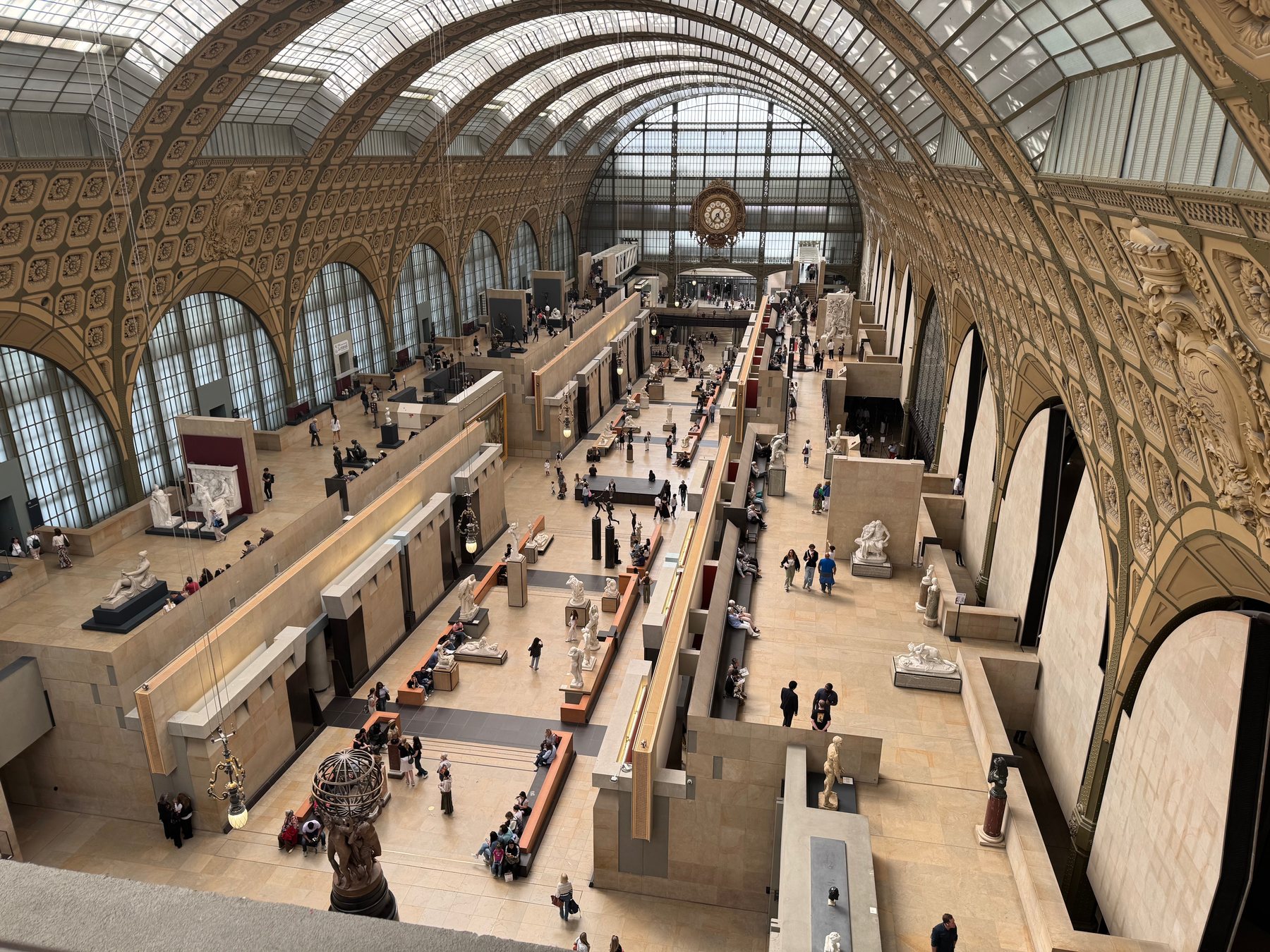
Lunch and a City View at the Musée d’Orsay
The historic museum restaurant was very good, although crowded. We found a varied menu, attentive service, and one of the better dining experiences we have had in Paris. Museum restaurants change menus and sometimes require their own wait, so do not build a tight timed entry immediately after lunch.
Near the upper galleries, the museum’s clock and seasonal terrace areas offer impressive views across the Seine toward the Right Bank. The museum also displays a detailed cross-section model of the Palais Garnier, including its public rooms, auditorium, stage, and backstage organization. Seeing it after touring the real opera house helped connect the decoration to the building underneath.
Day 4 Option: Versailles—Beautiful, but Not Our Favorite Day
Versailles began as a royal hunting lodge before Louis XIV transformed it into the center of the French court and government. The palace is famous for spaces such as the Hall of Mirrors, while the wider estate includes formal gardens, fountains, the Grand and Petit Trianon, and Marie Antoinette’s estate. Historically and artistically, there is no question that it matters.
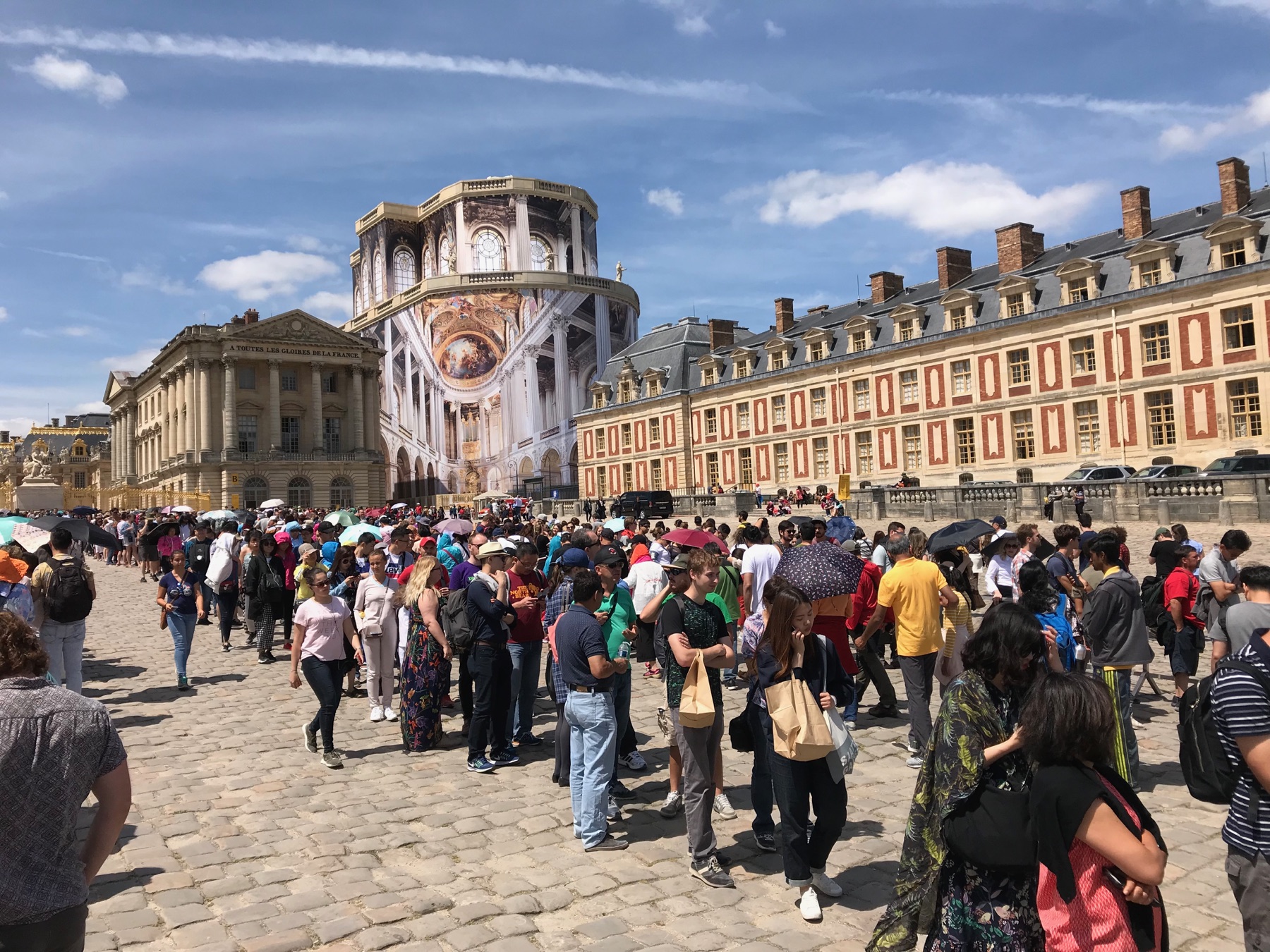
Our actual visit was a huge letdown. The train ride west seemed to take about 45 minutes, followed by a walk from the station to the entrance. Despite already having tickets, we encountered a line that appeared to take 60 to 90 minutes. Once inside, the crowd moved through the rooms like sardines. We could barely stop to see what we had come to see and mostly looked for each room’s exit until we reached the gardens and fresh air.
The grounds were beautiful. The interior experience was not. A timed ticket controls your admission period; it does not guarantee an empty security line, quiet rooms, or space in the Hall of Mirrors. If Versailles is important to you, choose the earliest practical time, avoid peak summer weekends when possible, allow a full day, and decide whether the gardens and wider estate matter more than checking off every palace room.
A famous place can be historically significant and still be the wrong experience for a particular traveler. We would not make Versailles essential in a first Paris itinerary unless its history, architecture, or gardens are a genuine priority. A slower day in Paris may be the better choice.
Eating in Paris When the Menu Is Only in French
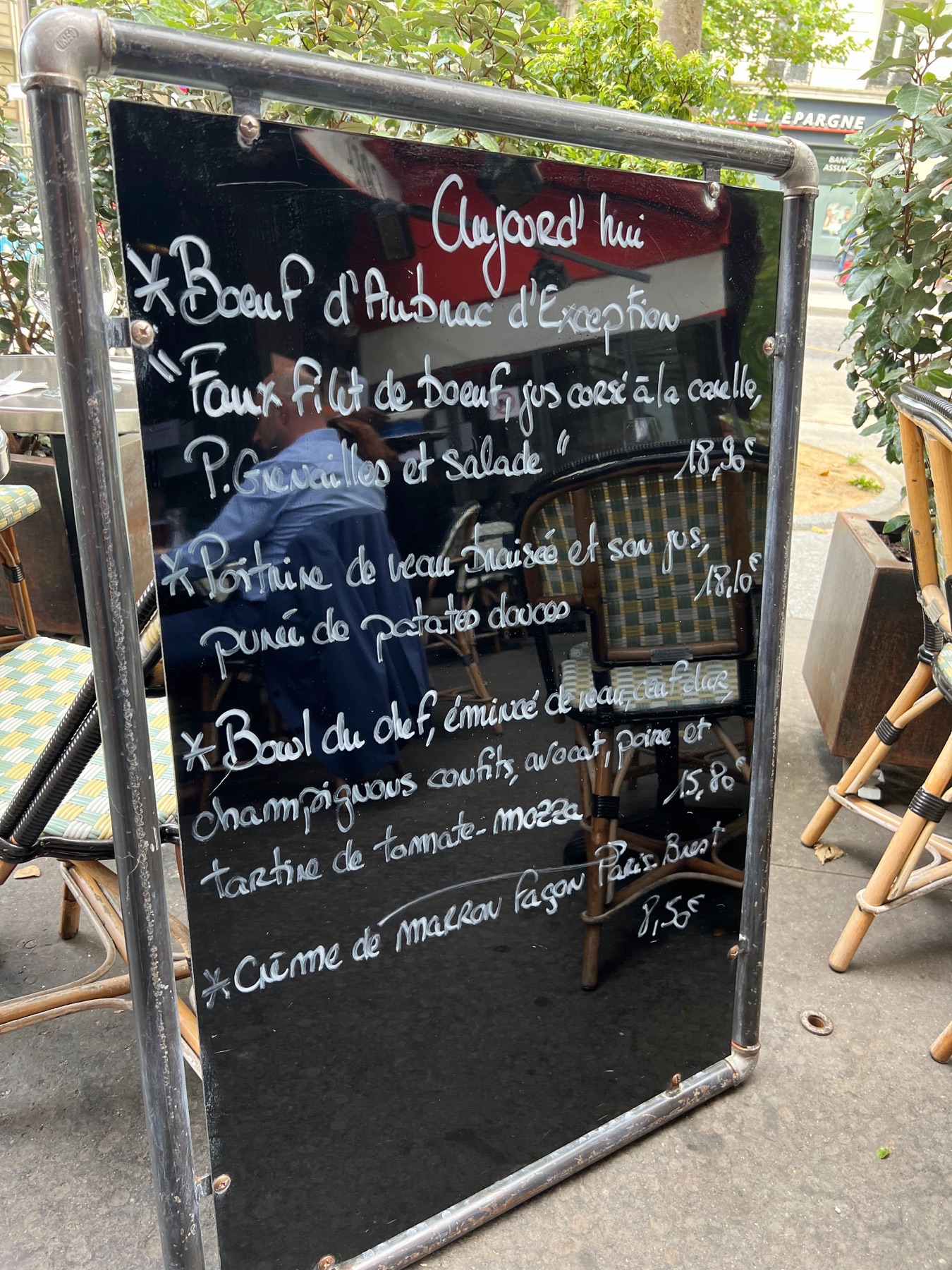
Finding food was never especially difficult once we stopped worrying about looking like experts. A translation app helps, and many restaurants have an English menu if you ask. Chalkboard menus outside smaller cafés may be entirely in French, which can feel intimidating when you are hungry and holding up the sidewalk.
Our practical method was to walk by slowly and look at what people were eating. If the plates looked good, we found a table and asked for the English menu. Pointing politely to a nearby dish works too. You do not need perfect French, but a greeting and a patient tone go a long way.
The Water Question: Ask for a Carafe
Restaurant water works differently from what many Americans expect, but free tap water is not actually hard to obtain in Paris. Ask for une carafe d’eau—a carafe of tap water—rather than simply ordering water. If you request bottled water, you should expect to pay for it, and the server may ask whether you want still water or sparkling water.
The same distinction appears on menus as still, sparkling, or sometimes with and without gas or bubbles. Free refills of bottled soft drinks are not the norm. We enjoyed trying European Fanta flavors and recipes, while Coca-Cola, Coke Zero, and occasionally Coca-Cola Light were familiar options.
Carry a reusable bottle for sightseeing and use public drinking-water fountains where available. In summer, hydration is too important to wait until everyone is seated at a restaurant.
Departing From Charles de Gaulle Airport
We used Paris Charles de Gaulle Airport for the final flight home on two of our three trips. Treat departure day as a travel day. CDG is large, terminals and check-in areas matter, and the journey from central Paris can be affected by traffic or rail disruptions.
Compare the RER B, a taxi, and a prearranged transfer based on your terminal, luggage, group size, hotel location, and flight time. The cheapest option on paper is not always the easiest at the end of a multi-country trip. Leave enough time to reach the correct terminal, check bags, clear security, and handle the unexpected without ending the vacation in a sprint.
Disneyland Paris Is a Separate Trip Within the Trip
Disneyland Paris is roughly a 40-minute regional-train ride from central Paris when the direct RER A journey is operating normally. It is the reason Paris entered our plans in the first place, but it deserves its own article rather than a rushed paragraph inside a city itinerary.
Do not casually add the resort as an afternoon extra. Transportation, park tickets, hotel strategy, dining, attraction priorities, and the number of park days all affect whether it feels worthwhile. I will cover our experience separately.
What I Would Book Before the Trip
Book the Paris Catacombs, any Eiffel Tower ascent, the Palais Garnier visit, and the museum time slot that matters most before departure. Reserve Eurostar and other long-distance rail when the schedule and fare work for the complete trip, not simply because one departure looks cheapest.
For a Seine sightseeing cruise, advance purchase is convenient but may not save much waiting. For Versailles, a timed ticket is necessary planning—not crowd protection. Recheck official schedules shortly before travel because museum galleries, theatre access, rail service, attraction hours, and temporary exhibitions can change.
Is 96 Hours the Right Amount of Time in Paris?
Four full sightseeing days are enough for a strong first visit without pretending you have completed Paris. This plan covers the Eiffel Tower area, a Seine cruise, the Champs-Élysées, Arc de Triomphe, Catacombs, Palais Garnier, Musée d’Orsay, and an optional day at Versailles.
If you have only 72 hours, skip Versailles and protect one museum, one river experience, and the attractions that fit your actual interests. If you have five or six days, add the Louvre, Montmartre, Sainte-Chapelle, the Latin Quarter, a food tour, or a deliberately unscheduled neighborhood day.
Paris may become one of your favorite cities even though it has never become one of ours. The right itinerary is not about proving that a popular destination is wonderful. It is about choosing the experiences that make the destination worthwhile for you—and leaving enough breathing room to enjoy them.