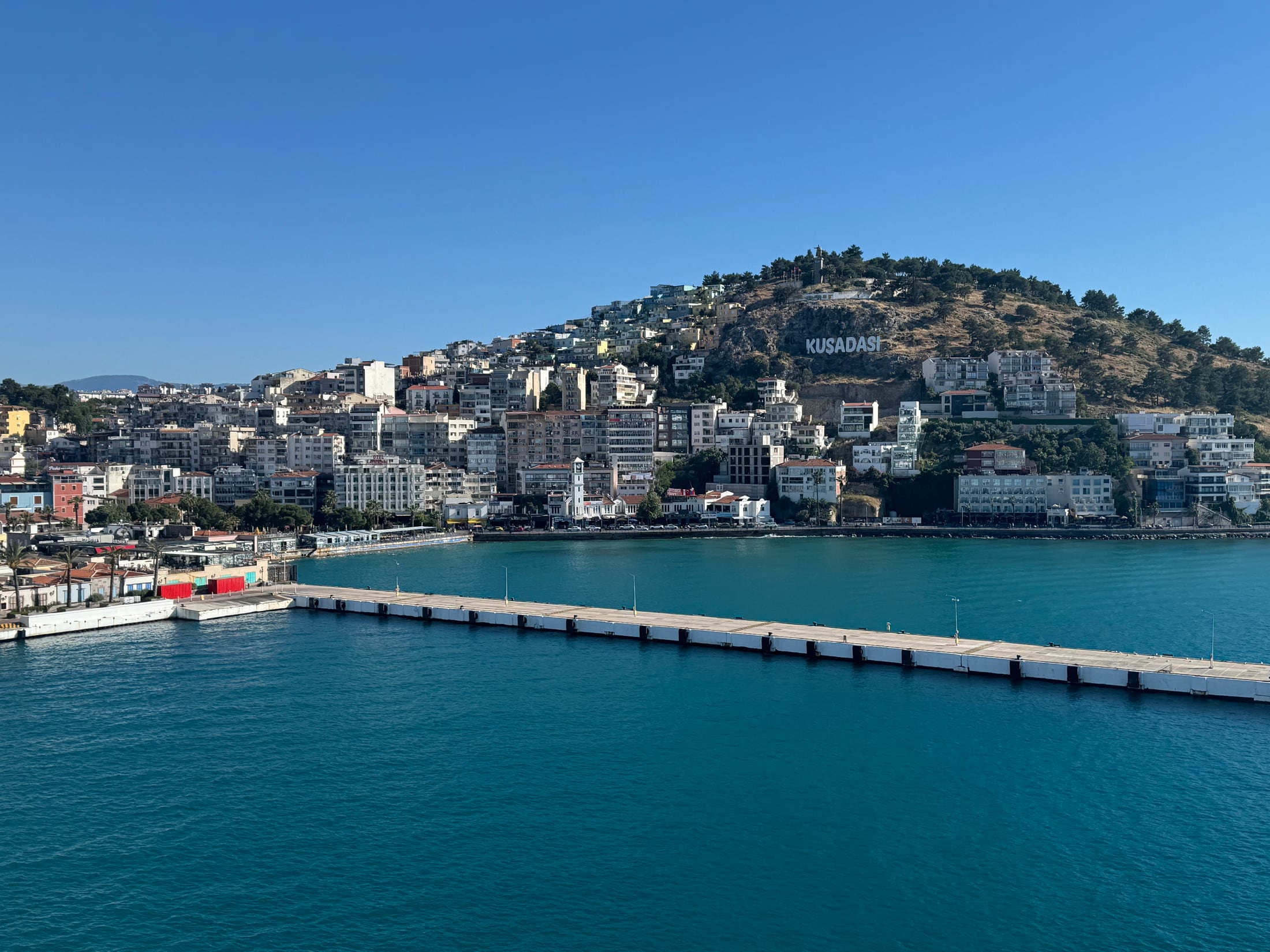
Personally Experienced · Last verified 2026-08-31
Explore Europe
Quick Take
A busy cruise day that felt like an introduction, not a complete Türkiye trip
- When we went
- June 2026 on a Mediterranean cruise
- Our route
- Kuşadası · Ephesus · Şirince · Selçuk area
- Walking reality
- Uneven ancient surfaces, slopes, heat, and limited restrooms
- Biggest surprise
- How genuinely warm every interaction felt
Our cruise ship docked directly in Kuşadası in June 2026, giving us roughly half a day for our first experience in Türkiye. That sentence is also the limit of my expertise: this is not a guide from someone who has explored the entire country. It is the story of one very full port day—and why those few hours made us want much more time.
The area near the port had exactly what you would expect when a large cruise ship arrives: merchants, souvenir shops, and plenty of signs aimed at visitors. What we did not feel was uncomfortable pressure. Shop owners invited people to look, but the atmosphere felt welcoming instead of aggressive. That first impression continued all day.
We joined an organized bus excursion that combined Ephesus, the hillside village of Şirince, and a Turkish rug showroom near Selçuk. It was a busy itinerary, but it gave us three very different views of the region: a famous ancient city, a village where we could slow down and wander, and a traditional craft presented on an almost unbelievable scale.
Interactive map
Our Kuşadası, Ephesus, Şirince, and Selçuk-area excursion
Follow our June 2026 shore-excursion route from the Kuşadası cruise port to Ephesus, Şirince, and Aladdin’s Rug Warehouse along the main road between Kuşadası and Selçuk.
Loading interactive map…
Location 1 of 4
Kuşadası cruise port
Where our ship docked and our organized half-day excursion began and ended.
Map markers are approximate. Map data © OpenStreetMap contributors; tiles by OpenFreeMap.
The Road from Kuşadası Was Part of the Experience
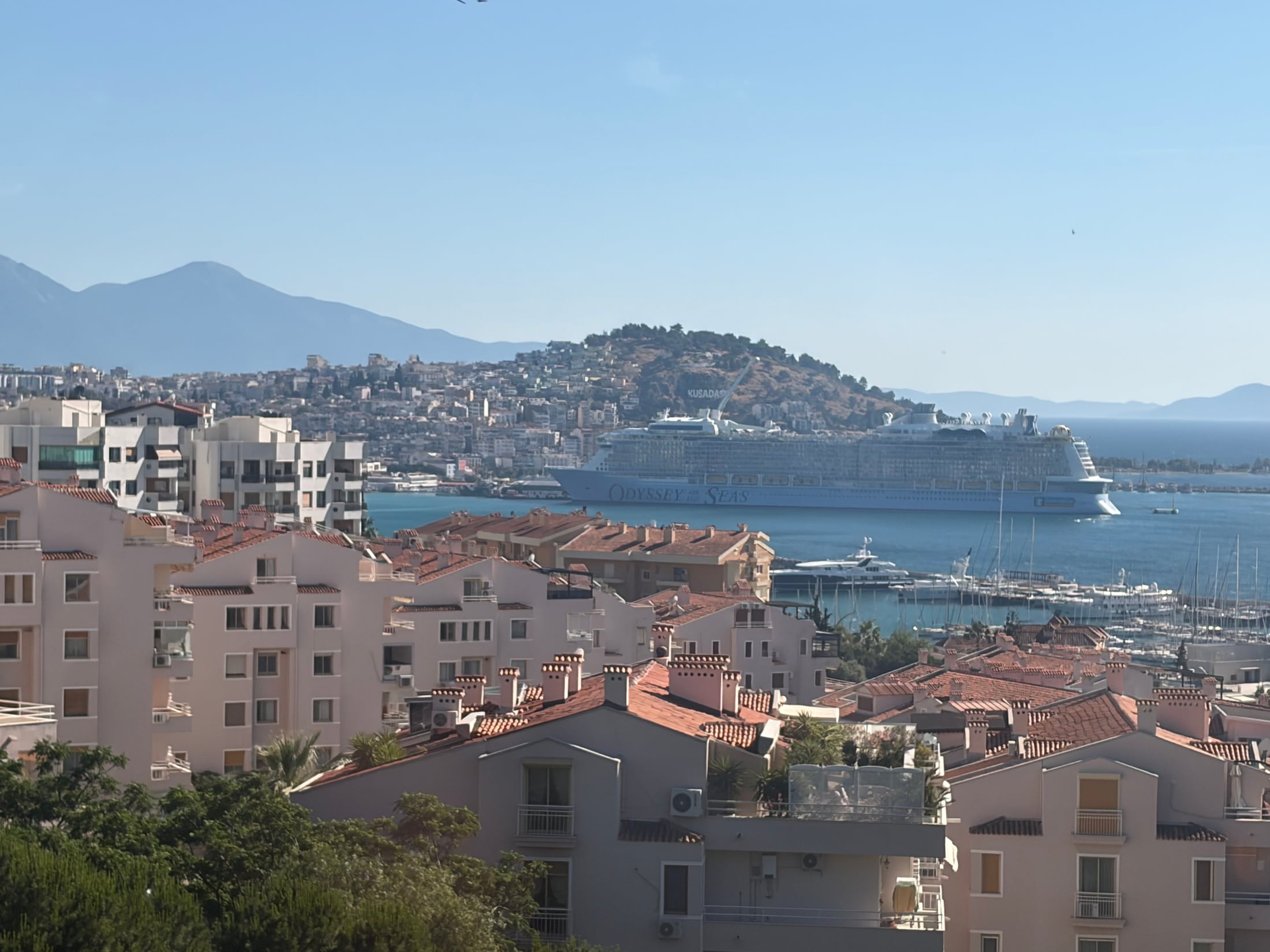
Leaving Kuşadası by bus, the drive became more scenic as we gained elevation. We could look back toward the coast, the marina, our ship, and the layers of hills around the Aegean. A shore excursion description tends to focus on the named stops, but this was one of those transfers where I was glad to have a window seat.
Ephesus was clearly not our private discovery. Tour buses were arriving in numbers, and the site felt busy from the beginning. For a cruise passenger, that makes the structure of the excursion important. The meeting point, guide, entrance used, walking direction, and return time all matter when several busloads are moving through the same ancient streets.
Ephesus Made More Sense Once Our Guide Put People Back Into It
Ephesus was one of the great cities of the ancient Mediterranean. It developed through Greek and later Roman periods, and when Rome took control of Asia Minor it became the capital of the Roman province of Asia. The ruins visitors walk through today include public streets, civic and religious buildings, shops, homes, baths, fountains, the Library of Celsus, the Temple of Hadrian, the Terrace Houses, and the Great Theatre.
I am not a historian, and a list of ancient buildings would not have held my attention in the same way on its own. Our guide told stories about how people lived, moved through the city, gathered, worked, and used these spaces. Suddenly we were not simply looking at old stones. We were trying to picture a functioning city full of people who had ordinary routines in a place that now feels monumental.
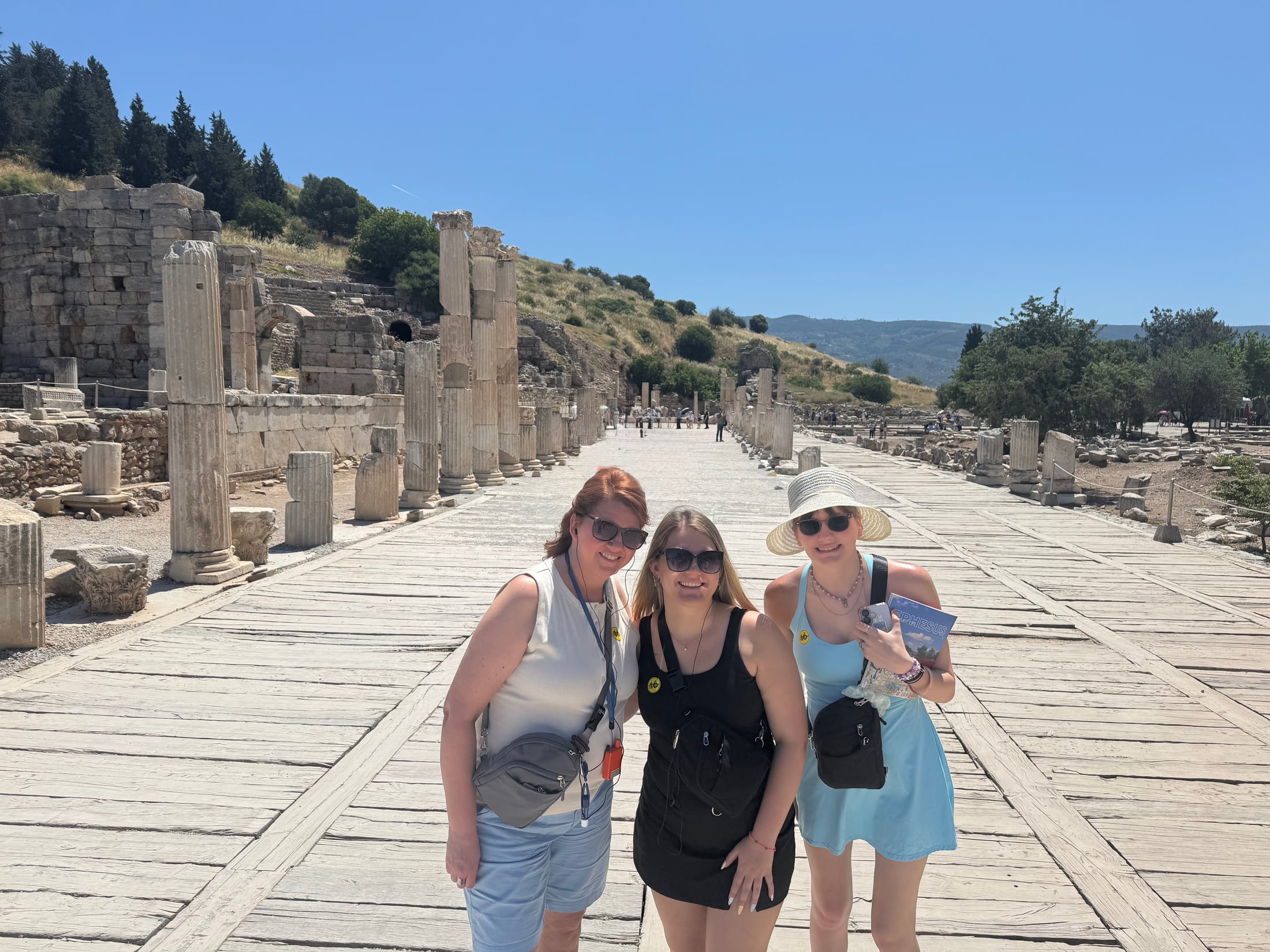
The marble-paved streets made that especially easy to imagine. We were walking through the same physical plan that once connected major parts of the city, with columns, carved fragments, and building facades rising around us. The Terrace Houses, where included in a ticket and tour plan, add a more domestic view through surviving mosaics, wall paintings, and marble decoration from wealthy homes.
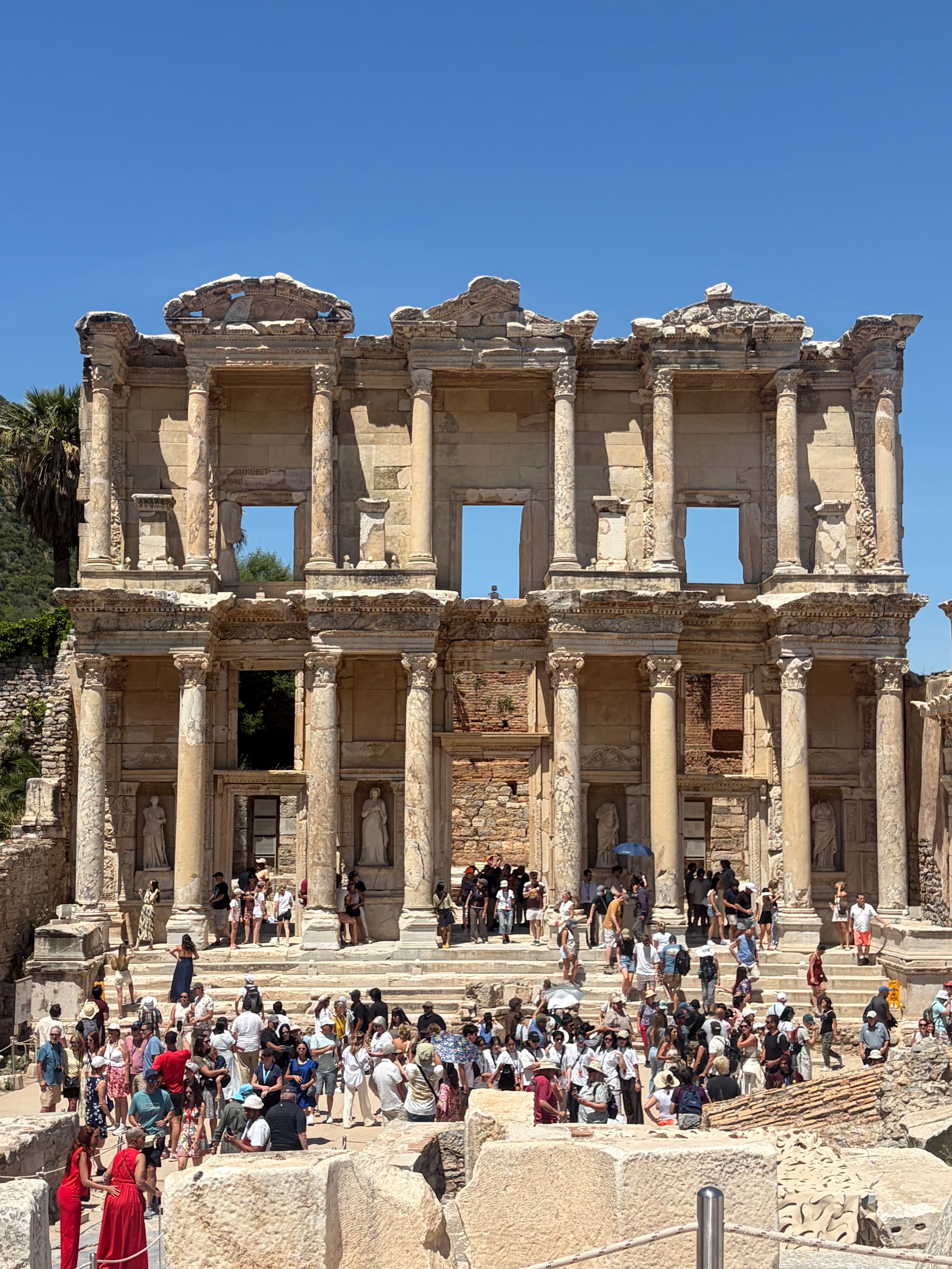
The Library of Celsus Was Our Favorite Photo Stop
The Library of Celsus was one of our favorite sights. Its reconstructed two-story facade is detailed enough to command attention even when the area in front is full of visitors—and during our stop, it definitely was. Columns, niches, statues, and carved stone make it feel more like a complete building than many ruins do at first glance.
This was also an excellent photo location, although getting a photograph without a crowd would have required a different schedule or a small miracle. I do not mind that our pictures show people. They capture the reality of visiting one of Türkiye’s best-known archaeological sites on a summer cruise day.
The Great Theatre Was Enormous, Scenic, and Awkward During Our Visit
The Great Theatre is carved into the slope of Panayır Hill and could hold roughly 25,000 spectators. It hosted performances and civic gatherings, and evidence indicates it was later used for gladiatorial contests as well. Even knowing the number does not quite prepare you for its scale when it opens up beside the ancient streets.
It was one of the most scenic parts of Ephesus for us, but construction made access around that area somewhat awkward during our June 2026 visit. I would treat that as a snapshot of our day, not a permanent warning. Conservation work, temporary routes, and open areas can change, so a current guide or official visitor information will be more useful than assuming our exact path will still apply.
What the Glossy Ephesus Excursion Description May Not Tell You
Walking through Ephesus is not the same as walking through a modern attraction with uniformly paved paths. We encountered uneven ancient stones, loose-looking rocks, slopes and downhill portions, and places where footing could feel a little unstable. Good walking shoes are not a decorative suggestion here.
That does not mean Ephesus is simply inaccessible. It means travelers with limited mobility, balance concerns, a stroller, or difficulty on slopes should investigate the specific tour instead of relying on a general statement that it visits Ephesus. Ask which entrance and exit the tour uses, how much of the route is downhill, whether there are stairs, what surfaces are involved, and where the bus meets the group.
Restrooms were limited along the main walking route during our visit. My very practical advice is to use facilities when they are available before beginning the walk. Do not assume another restroom will appear just after the next ruin. This is not the most glamorous Ephesus tip, but it may be the one somebody is happiest to know in advance.
Şirince Was the Unexpected Change of Pace We Needed
After Ephesus, we traveled into the hills near Selçuk to Şirince. The village felt entirely different from the archaeological site: narrow streets, traditional white buildings with dark wood trim, restaurants, small shops, vineyards and orchards, and green hills rising behind it all. Our guide told us that hotels and other overnight accommodations in the village are typically booked 18 to 24 months in advance, which gave us a sense of just how popular Şirince is with overnight visitors.
We had a buffet lunch included with the tour. My plate included tomato-seasoned bulgur pilaf, white rice, cooked greens, cherries, chicken with peppers and onions, an eggplant-and-meat dish, and İzmir köfte—meatballs served with potatoes and peppers in tomato sauce. It was a generous sampling of homestyle Turkish food.
The lunch included about half a dozen wine samples. These were not the grape varietals most Americans expect from a standard tasting. Şirince is known for local fruit wines, with flavors that can include peach, pomegranate, blackberry, mulberry, quince, cherry, and other fruits grown in the region.
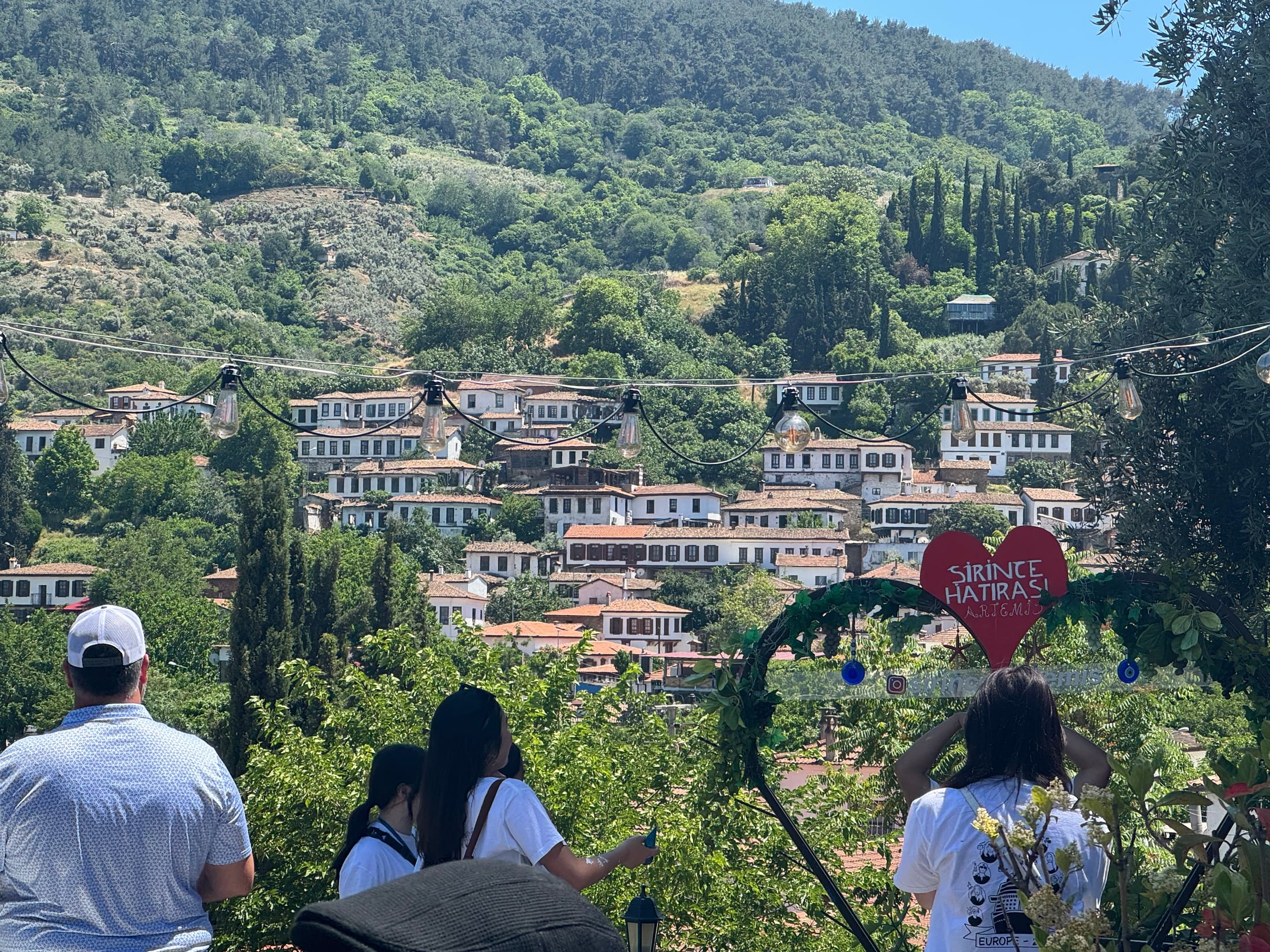
Ninety Minutes of Wandering Was Better Than Another Timed Stop
After lunch, we had about 90 minutes to explore independently. That unstructured time was one of the best parts of the excursion. We could follow the narrow streets, look into shops, stop when something caught our attention, and let the village feel like a place rather than another item on a schedule.
There was plenty of merchandise aimed at tourists, but it was mixed with attractive jewelry, woven and textile pieces, local products, souvenirs, small food-and-drink stops, and an impressive amount of ice cream. We were not racing toward one essential attraction. The pleasure was in strolling and seeing what was around the next turn.
If I returned to Şirince, I would want more of exactly that: time without a guide counting down the next departure. The village seems well suited to a leisurely meal, a tasting, and a walk long enough to get beyond the first row of shops.
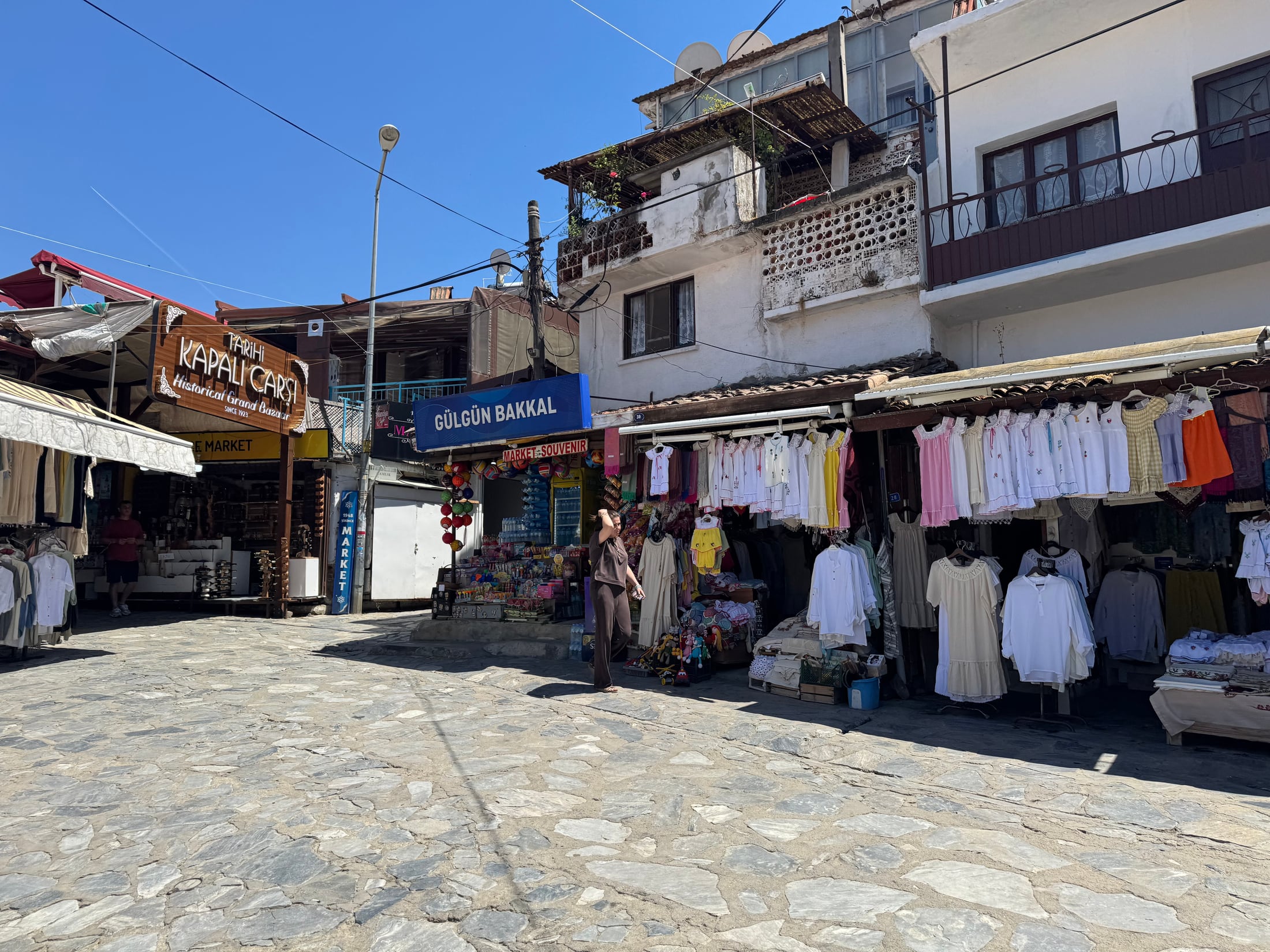
The Rug Stop Was Far More Interesting Than We Expected
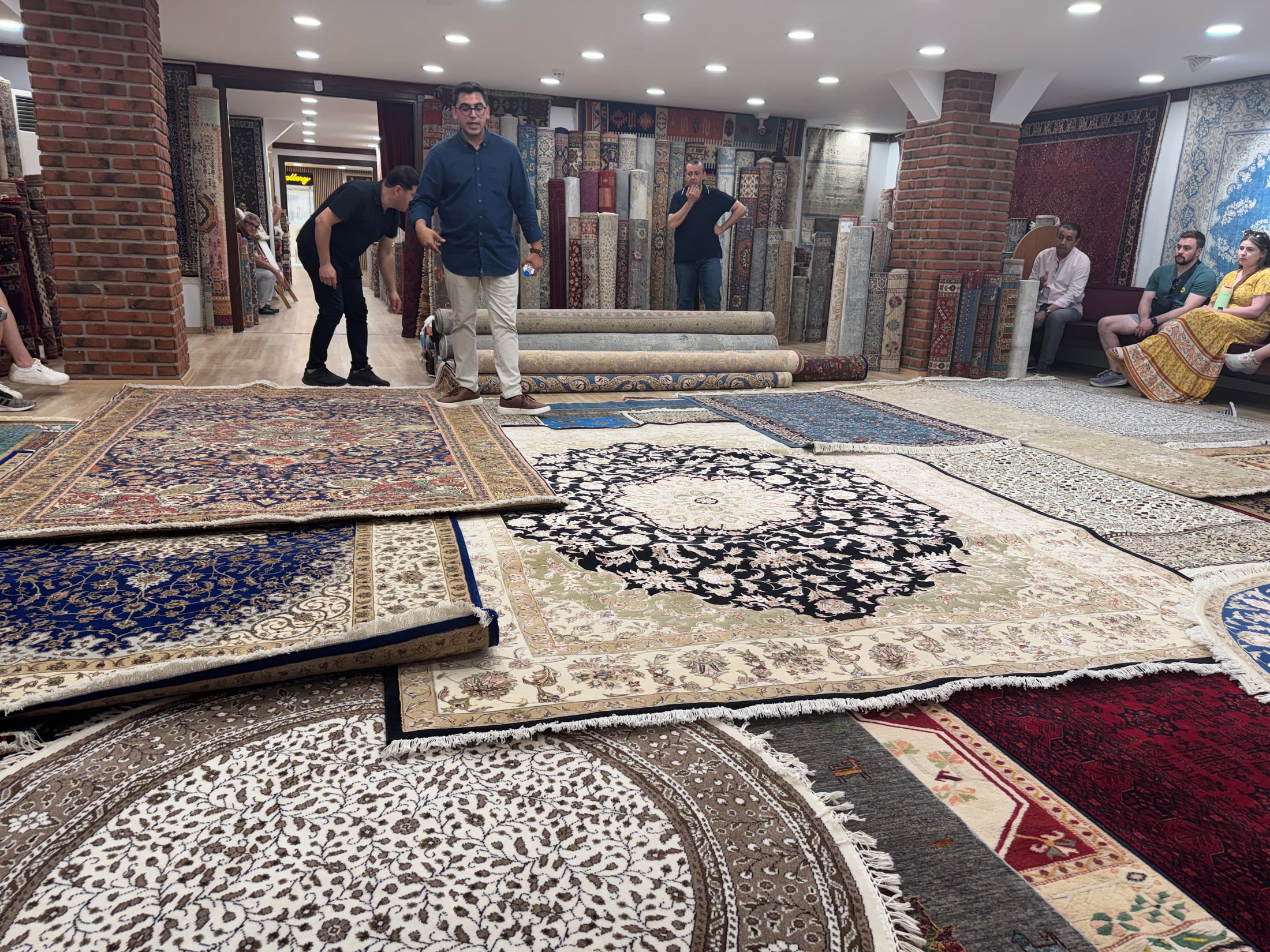
Our final major stop was Aladdin’s Rug Warehouse near Selçuk, along the main road leading in and out of town. The showroom held thousands of rugs, and seeing so many styles, sizes, and patterns together made the scale of the craft immediately clear.
This could easily have felt like an obligatory shopping stop added to a tour. Instead, learning about the materials and labor made it genuinely fascinating. Traditional Anatolian carpets may be made with wool, cotton, silk, or combinations of them. Some are hand knotted; kilims use flat-weaving techniques. Regional patterns and motifs can carry distinct identities, and natural dyes were historically made from plant and other organic sources, although modern carpets do not all use the same materials or methods.
The time required varies enormously. A small piece is not the same undertaking as a large, fine silk carpet with a high knot density. Depending on size, material, complexity, and the number of people weaving, a detailed handmade carpet can take months and in some cases years. That does not mean every rug takes years, and it certainly does not mean every rug should carry the same price.
Three people on our tour bus purchased rugs costing five figures. We were stunned. After seeing the workmanship and understanding more about how some pieces are produced, it became easier to see why a collector might treat a rug as artwork rather than simply a floor covering. We remained observers—and bought much smaller souvenirs.
Turkish Coffee Deserved Its Own Small Moment
At the rug stop, we also sampled Turkish coffee. It was remarkably good. Traditional Turkish coffee uses beans ground to a very fine powder and brewed slowly with water, often with sugar, in a small pot. It is served unfiltered in a small cup, so the texture and the grounds settling at the bottom are part of the experience.
I do not need to turn one cup into a coffee lecture. It was strong, smooth, memorable, and another example of hospitality woven into the day rather than treated as a performance separate from it.
The People Were the Part We Kept Talking About
Across the day, we interacted with shop owners, restaurant workers, our guide, bus drivers, merchants, people at the rug warehouse, and other locals. Every person we happened to meet was friendly. I want to phrase that carefully because one shore excursion cannot define an entire country or nationality. It can only describe our experience, and our experience was exceptionally warm.
It also did not feel as though everyone was simply being pleasant because tourists might spend money. There was an ease and sincerity to the hospitality that stood out enough that we talked about it afterward. The shop owners near the port had not been pushy. The people guiding, feeding, driving, serving, and speaking with us throughout the excursion made us feel welcome.
Ephesus may have been the historical reason to choose the excursion, but the people became one of the strongest reasons we wanted to return. Ancient sites can make you curious about the past. A genuinely good human experience makes you curious about the country as it is now.
Where We Would Go With More Time
We have not personally visited all of the destinations in this section. These are the places I would compare when turning our brief introduction into a longer Türkiye itinerary, based on current planning research and the kind of trip a traveler wants.
İstanbul would be the cultural and historic anchor for many first trips, with Hagia Sophia, the Blue Mosque, Topkapı Palace, the Basilica Cistern, the Grand Bazaar, and time on the Bosphorus. Cappadocia offers an entirely different landscape: fairy chimneys, cave hotels, valleys, underground cities, and the famous sunrise hot-air balloons.
Pamukkale and Hierapolis would fit especially well for someone who loved Ephesus, pairing white travertine terraces and thermal waters with another major ancient site. Bodrum shows another side of the Aegean through coastline, beaches, resorts, restaurants, marina life, and history. Antalya and the Turkish Riviera combine Mediterranean beaches and resort stays with substantial archaeological sites nearby.
A western route could also stay closer to what we already tasted. İzmir, Çeşme, and Alaçatı can combine naturally with Kuşadası, Selçuk, Ephesus, and Şirince, creating more time for the Aegean coast instead of treating the region as a single bus ride from a ship.
A Cruise Stop Was Just the Beginning
A Mediterranean cruise can be a fantastic first taste of Türkiye. We unpacked once, arrived directly in Kuşadası, and experienced an extraordinary ancient city, a hillside village, local wine, a traditional craft, and Turkish coffee in a single day. That is a strong introduction.
It also barely scratches the surface. I can help compare cruises that include Kuşadası and Ephesus, look closely at shore-excursion walking requirements, and decide whether an organized tour, private guide, or different pace suits the travelers involved. I can also build pre- or post-cruise time into the journey or help plan a longer customized Türkiye itinerary combining cities, historical sites, villages, and the coast.
If Türkiye has been on your list, let’s figure out whether you want your first taste from a cruise ship—or enough time to really explore.